
Ports Capacity and Connectivity
Header description
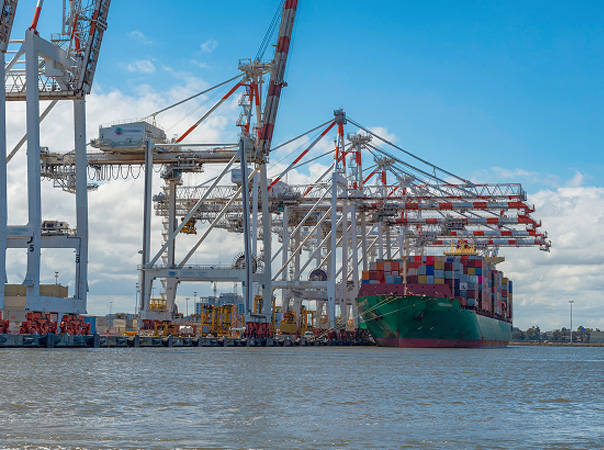
Australia’s ports underpin national productivity and export competitiveness, connecting producers, freight networks and global markets.
Airports
Increasing airport connectivity
Aviation is a key part of Australia’s transport system, providing passenger transport services for international and domestic travellers between highly dispersed population centres and vital connectivity for rural and remote communities.
While air freight accounts for a small share of Australia’s overall freight task by mass – less than 0.03% of domestic freight in 2023-2474 – it plays an important role in moving high value freight, including sensitive or perishable goods.75 Total air freight volumes through Australia’s capital city airports are projected to increase by 42% on average by 2050.76 Together, maritime ports and airports form an integrated network essential to Australia’s trade resilience and national connectivity.
Table 11 outlines current and projected passenger numbers, projected air freight growth, rail connectivity, and fuel pipeline availability across Australia’s capital city airports. Significant passenger growth (over 135%) is expected in Brisbane, Darwin, Melbourne and Perth airports, with Brisbane and Perth also expecting over 80% growth in total air freight to 2050.
Although airport capacity data is not publicly available, capital city airports face rising passenger and freight demands, highlighting the importance of runway and terminal capacity, as well as fuel pipeline and rail connectivity. To meet forecast demand, runway and terminal capacity upgrades are progressing at Melbourne and Perth airports. Upgrades may be required at Brisbane, Darwin and Hobart airports to meet projected passenger and freight growth to 2050.
| Airports |
Airport passengers |
Projected airport passengers |
Projected passenger growth |
Projected air freight growth |
Fuel pipeline |
Rail connection |
|---|---|---|---|---|---|---|
|
(million) |
(million) |
(%) |
(%) |
|||
| Adelaide |
8.4 |
15.1 |
80 |
46 |
|
|
| Brisbane |
23.8 |
55.4 |
133 |
82 |
|
|
| Canberra |
2.8 |
5.1 |
82 |
- |
|
|
| Darwin |
1.9 |
4.8 |
153 |
40 |
|
|
| Hobart |
2.8 |
6.2 |
121 |
- |
|
|
| Melbourne |
36.0 |
82.3 |
129 |
41 |
|
|
| Perth |
14.2 |
30.9 |
118 |
83 |
|
|
| Sydney |
41.8 |
88.2 |
111 |
18 |
|
|
| Western Sydney |
- |
|
|


Source: Infrastructure Australia analysis of Australian aviation forecasts – 2024 to 2050 Research Report 157, Chapters 4 and 7. Highlighted cells indicate values that are above the average for their respective column.
10-year national priorities
Australia’s airports are critical gateways for trade, tourism and connectivity. To support economic growth and global competitiveness over the next decade, there should be a focus on strengthening airport infrastructure, improving resilience and ensuring seamless integration with freight and passenger networks.
Fuel pipeline connectivity to major international airports supports operational resilience and efficiency. The new Western Sydney International Airport, due to open in 2026, will provide significant new passenger and air freight capacity, helping to meet Sydney’s future aviation demands.78 The 2026 Infrastructure Priority List includes the Western Sydney Airport fuel pipeline proposal as a priority for future investment in the 2-4 year pipeline. Without direct fuel pipeline infrastructure to Western Sydney Airport, 50 to 65 B-double fuel tanker deliveries per day would be required via Sydney roads.79
Airport rail connections for Australia’s major capital cities support improved access and reduced urban road congestion. Melbourne is Australia’s biggest capital city without airport – rail connectivity. The 2026 Infrastructure Priority List includes Melbourne Airport Rail as a priority for future investment in the 2-4 year pipeline to support delivery of the full project. The Australian Government has committed $7 billion to the construction of Melbourne Airport Rail, which includes the redevelopment of Sunshine Station, to provide critical rail connectivity between Melbourne’s CBD and the airport.