
Ports Capacity and Connectivity
Header description
Australia’s ports underpin national productivity and export competitiveness, connecting producers, freight networks and global markets.
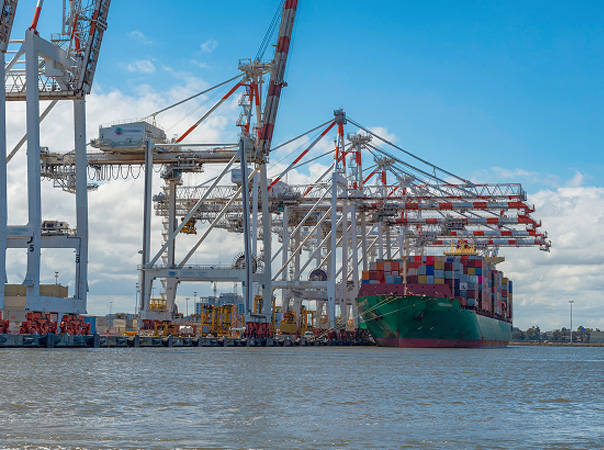
The Australian economy is reliant on international trade, with exports accounting for nearly 25% of GDP in 2024.32 The vast majority (over 99%) of Australia’s international trade by volume moves through our maritime ports,33 which exported $467 billion worth of sea freight in 2023-24. The value of Australia’s international sea freight has increased at an average of 6.4% each year over five years to 2023-24, highlighting the growing importance of maritime trade to Australia’s economy.34 This underscores that Australia’s global competitiveness depends on the productivity, capacity and resilience of its maritime gateways.
Australia’s trade growth trajectory is increasingly challenged by structural and operational constraints. Congested road and rail connections to ports, ageing landside infrastructure and limited intermodal capacity create inefficiencies across supply chains. The global shipping industry is also undergoing rapid transformation, with fleet modernisation introducing larger vessels that some Australian ports cannot currently accommodate.33
Ports and landside supply chain infrastructure are highly important to the competitiveness of Australian businesses that rely on these gateways to import and export raw materials and manufactured goods.
Australia’s ports can significantly improve their productivity through the adoption of automation and digital technologies. The Productivity Commission estimates that addressing inefficiencies at Australia’s major container ports alone could deliver up to $600 million in annual savings.35 Progress is often constrained by rigid industrial agreements and fragmented technology systems. Bulk ports share similar barriers but also present opportunities for targeted automation, including automated shiploaders and predictive maintenance.
The Port of Brisbane’s Green Button project trialled a new vessel management system to optimise shipping movements within the Port of Brisbane shipping channel to reduce emissions and support productivity. This project demonstrates how digital solutions can address delays and improve coordination, while also delivering environmental benefits.
State and territory governments are responsible for land use planning and controls for ports, adjacent land and connecting transport systems. Port owner/operators (mainly private sector) are responsible for port operations and investment, under government regulatory frameworks. The absence of a recent national ports strategy highlights an opportunity to improve coordination and strategic alignment across jurisdictions, informed by current trade patterns, infrastructure capacity and emerging trends.