
Ports Capacity and Connectivity
Header description
Australia’s ports underpin national productivity and export competitiveness, connecting producers, freight networks and global markets.
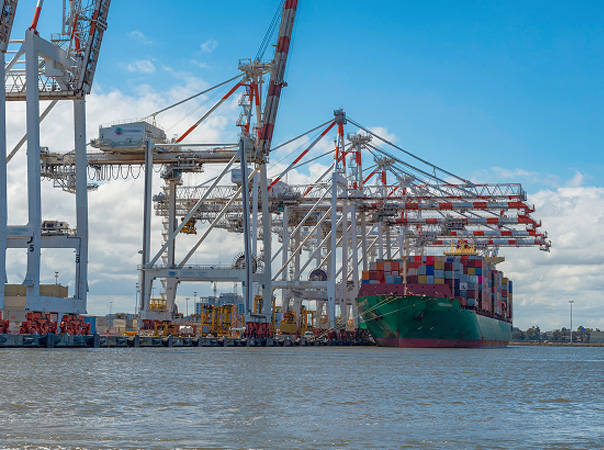
Maritime Ports: Containers
Australia’s container trade is forecast to grow significantly over the coming decades, with import volumes at major ports such as Brisbane, Fremantle and Adelaide projected to increase by 34%, 55% and 66% respectively, by 2029-30.36 Container trade growth is predominantly driven by imports, which make up the majority of containerised trade, reflecting Australia’s reliance on overseas goods to support domestic consumption and production. Australia’s containerised exports are predominantly empty containers, which were the single largest category of containerised exports from Australia in 2020.37
Australia’s major container portsiv are becoming more productive but continue to lag behind our trading partners for key indicators, including vessel schedule reliability38 and ship turnaround time.39 Nearly all Australian container ports ranked in the bottom 20% of the ports assessed by the World Bank in the inaugural Container Port Performance Index (CPPI) in 2020. Port Botany, Port of Brisbane and Port of Fremantle ranked in the bottom 20% in the most recent CPPI rankings (2024).v,43
While Australia’s five major container ports handle most of Australia’s containerised trade, smaller regional ports play a critical role in supporting national supply chains and regional economies. Ports such as Burnie, Darwin and Townsville act as key gateways for container trade, as well as agricultural and mining exports. These ports provide connectivity for industries located far from metropolitan hubs. Analysis on many of Australia’s regional ports is constrained by the absence of nationally consistent data, which limits the ability to understand relative performance and possible infrastructure constraints or gaps. See the Maritime Precincts section for further information on specific ports and maritime precincts of national significance, including associated proposals on the 2026 Infrastructure Priority List.
Expanding port capacity
Australia’s containerised trade growth is increasing pressure on port capacity. The global trend towards larger container vessels raises questions about whether and when to invest in infrastructure upgrades to accommodate them.40 While ships visiting Australia remain small by international standards, projections suggest that vessels of 15,000 TEUvi could arrive by the late 2020s, with 18,000 TEU ships possible by the early 2040s.41 This shift would require significant investment in both landside and portside infrastructure, including upgrades to terminal operations, deepening and widening shipping channels and adding cranes to maintain service levels as vessel sizes increase.
Infrastructure Australia previously recognised the opportunity for infrastructure improvements that enable larger vessels access to Australian ports on the east coast, although this would require a coordinated response, as shipping companies prefer to service multiple ports along a route, therefore the capacity of all ports along that route will influence the choice of vessel.
Many of Australia’s major container ports also face capacity issues resulting from physical (space) constraints, which means that available land must be used efficiently.42
Australia’s major container ports are projected to experience long-term trade growth between 111% (Port of Melbourne) and 209% (Port of Brisbane). Table 8 identifies current and projected trade volumes for Australia’s major container ports, highlighting the extent of growth expected in the long-term.
| Port |
CPPI rank (2024)43 |
Container trade volume |
Projected trade volume |
Projected trade growth |
Projected trade growth |
|---|---|---|---|---|---|
|
|
('000 TEU/year) |
('000 TEU/year) |
('000 TEU/year) |
(%) |
|
| Port Adelaide |
266 |
413 |
1,254 |
841 |
204 |
| Port Botany |
357 |
2,815 |
7,300 |
4,485 |
159 |
| Port of Brisbane |
377 |
1,620 |
5,000 |
3,380 |
209 |
| Port of Fremantle |
379 |
886 |
2,300 |
1,414 |
160 |
| Port of Melbourne |
265 |
3,386 |
7,130 |
3,744 |
111 |
Note: Highlighted cells indicate values that are above the average for their respective column.
Port Adelaide, Port of Brisbane and Port of Fremantle are projected to experience the largest relative trade growth – 204%, 209% and 160% respectively, and will require associated capacity uplifts to meet projected trade demands in the future. Port Botany, Port of Brisbane and Port of Melbourne are expected to experience the largest absolute growth in trade to 2055 and beyond. The Port of Fremantle will be unable to accommodate the long-term projected trade growth shown in Table 8. Under a moderate growth scenario with the existing infrastructure, the port’s capacity is expected to be reached by around 2038.
In response to this projected growth, Australia’s major container ports are pursuing a range of capacity enhancement strategies. The Port of Melbourne is planning for new container trade capacity at Webb Dock North to be available by 2036 to mitigate capacity constraints forecast for 2037 by delivering a fourth international container trade terminal.50 The upgrades are in planning and being delivered by the Port of Melbourne as part of their Port Capacity Enhancement Program. The Port of Brisbane is progressing planning for the Channel Enhancement Program to respond to increasing vessel sizes and provide additional channel capacity for vessels by deepening and widening the existing channels.
To meet long-term container trade projections, NSW Ports is planning to develop a container trade terminal at Port Kembla to supplement available capacity at Port Botany, however this is not expected to be required until the late 2040s.51 Port Adelaide is expected to require additional berth capacity before 2054, which is complicated by waterside constraints related to channel and berth depths.
Although most of Australia’s imports move through container terminals in capital cities,37 bulk ports also play a role in supplying commodities such as crude oil, fertiliser and petroleum products. The Port of Geelong and Port Kembla both rank among the top ten ports by value and weight of Australia’s international sea freight imports.52 Port of Geelong infrastructure needs are considered in the Delivering Net Zero and a Clean Energy Economy section in relation to the 2026 Infrastructure Priority List proposal Enabling infrastructure for Renewable Energy Zones – Ports of Adelaide/Geelong to South-West REZ.
10-year national priorities
Alongside investment in automation and digital technologies, all of Australia’s major container ports require long-term infrastructure investment to accommodate projected trade growth. The Port of Fremantle faces acute capacity constraints, with existing infrastructure unable to support long-term trade growth and capacity expected to be reached by 2038.
Port capacity enhancements will be required to support projected container trade growth and address emerging capacity constraints. The 2026 Infrastructure Priority List identifies the Westport (Kwinana port development) proposal in Western Australia as a future investment opportunity in the 2-4 year pipeline to enable transition of container trade from the Port of Fremantle to a new facility in Kwinana.vii With Fremantle expected to reach capacity around 2040, Westport represents a proactive solution to support continued growth in container volumes.
Increasing port connectivity
The use of rail for freight transportation within our cities has been limited as rail journeys to and from capital city ports are typically short and often compete against passenger services on shared infrastructure, which reduces frequency and reliability.53
Investment in dedicated freight lines will improve service frequency and utilisation, enabling rail to better compete with road freight.54 In addition, investment in intermodal terminals can increase the share of freight moved by rail in and out of ports54 and for every 1% of the national freight task that moves to rail, society gains $72 million a year resulting from lower carbon emissions, safety and health benefits.55
Dedicated freight rail lines improve the efficiency and competitiveness of rail freight servicing Australia’s ports. Many existing rail freight connections operate on shared infrastructure, which has contributed to low rail mode share at key ports. Table 9 identifies which of Australia’s major container ports has a dedicated freight rail line and what proportion of containerised freight was moved on rail in 2022-23.
| City | Port |
Dedicated freight rail line |
Rail share (%) of port container trade (2022-23) |
|
|---|---|---|---|---|
| Adelaide | Port Adelaide |  |
Dry Creek – Outer Harbor Line |
13 |
| Brisbane | Port of Brisbane |  |
1 |
|
| Melbourne | Port of Melbourne | |
5 |
|
| Perth | Port of Fremantle | |
Fremantle Railway Line |
20 |
| Sydney | Port Botany | |
Port Botany Freight Rail Line and Southern Sydney Freight Line |
13 |
Source: Infrastructure Australia analysis of BITRE Yearbook 2025, Table 7.6; Waterline 70 Table 1.1. Highlighted cells indicate values that are below the average for their respective column.
The data highlights a clear correlation between dedicated freight rail infrastructure and higher rail mode share. Ports without dedicated lines – such as the Port of Brisbane and Port of Melbourne – reported the lowest rail mode share at just 1% and 5% respectively for 2022-23. While dedicated freight lines provide the greatest efficiency improvements, targeted upgrades to access, signalling and capacity on shared freight-passenger rail corridors can still support higher rail mode share.
In Melbourne, the Port Rail Shuttle Network is working to modernise Melbourne’s existing transport networks to better connect the Port of Melbourne to intermodal terminals56 and is supported by an Australian Government commitment of $38 million. The Port of Melbourne’s Our Plan for Rail describes a range of initiatives to support further separation of passenger and freight rail services to improve rail mode share, including connecting the future Western Interstate Freight Terminal (WIFT) to the port via a dedicated freight rail link.
At Port Botany, an expansion of on-dock rail capacity is underway, going from 1 million to 3 million TEU annually57 to increase rail freight mode share. This work is being privately funded and delivered by NSW Ports,58 with data showing that the mode share has increased from 13% in 2022-23 (as reported in Table 9) to 20% at the end of 2025.59
10-year national priorities
Port connectivity improvements require coordinated investment in dedicated freight rail corridors and integrated intermodal precincts to increase productivity, drive mode shift and support future trade growth.
Improving both rail and road connectivity to ports will reduce freight bottlenecks and strengthen Australia’s supply chain performance. The Westport enabling infrastructure (Anketell Road upgrades) proposal is an immediate priority for delivery investment recognising that road, rail and intermodal terminal upgrades will be key enablers of the broader Westport Program, delivering essential port connectivity to support efficient access to new port facilities. Upgrading Anketell Road is the initial priority, with additional infrastructure works planned in coming years to further enable the overall functionality of Westport.
Targeted investment over the next 10 years is required to support further mode shift to rail to meet Australia’s growing freight task and reduce road congestion. The Port of Brisbane freight rail improvements proposal is identified on the 2026 Infrastructure Priority List as a priority for future investment in the 5-10 year pipeline. The proposal is supported by an Australian Government commitment to develop a business case to consider options to improve freight rail capacity and connectivity to the Port of Brisbane to reduce congestion and boost productivity in South East Queensland.
_____
iv Container trade data is reported for Adelaide, Brisbane, Fremantle, Melbourne and Sydney ports in BITRE Yearbook 2025 and Waterline 70.
v The 2024 Container Port Performance Index assessed the performance of 403 container ports.
vi Twenty-foot Equivalent Unit (TEU) – standard unit of measurement used in shipping to describe the capacity of shipping containers.
vii Port of Fremantle (container port) and Port of Kwinana (bulk port) are existing ports in Perth, Western Australia.