
Delivering Net Zero and a Clean Energy Economy
Header description
Australia’s transition to net zero will require a rapid scale-up of renewable energy generation, transmission and storage, supported by enabling infrastructure and the decarbonisation of construction and transport.
By 2050, renewable energy is projected to supply 98% of electricity in the National Electricity Market (NEM).xv This renewable supply will be underpinned by a 422% increase in grid-scale wind and solar generation, around 6,000 km of new transmission lines and an 11-fold increase in battery storage.xvi,166
In Western Australia, the South West Interconnected System (SWIS) is expected to need almost 10 times current energy generation and storage capacity by 2042 (comprising 84% renewables, 8% storage and 8% gas) and over 4,000 km of new transmission lines.167 The North West Interconnected System (NWIS) also requires generation, storage and transmission infrastructure to support decarbonisation of mining and heavy industry in the Pilbara, and transition from fragmented, private networks to common‑use transmission to reduce duplication and system cost.xvii
Accelerated delivery of renewable energy, storage and transmission infrastructure is vital to meet Australia’s future need for clean, reliable and affordable energy, and to achieve national 2035 and 2050 emissions targets. In the NEM, two-thirds of aging coal-fired power stations will retire by 2035, in many cases earlier than publicly announced closure dates, with all others to retire by 2049.165 In the SWIS, state-owned coal generators will close by 2030.166 In the NWIS, electricity generation is currently sourced predominantly from fossil fuels (around 98%), and will require a substantial shift to renewable energy to support emissions reduction.168 Electricity consumption in the NEM is expected to nearly double by 2050 and increase 5-fold in the SWIS by 2042.
Renewables require supporting technologies to ensure grid stability and energy reliability. These include upgraded transmission and distribution networks, batteries and long-duration storage, flexible gas generation to provide back-up supply, and synchronous condensersxviii to keep the power system stable (by absorbing or injecting reactive power).165 Governments have a role to play in planning transmission and battery storage, which requires a rethink of how electricity grids are currently organised around coal-fired power and one-way energy flows (refer Figure 2). New transmission infrastructure will be required to carry electricity from areas of renewable energy resources to consumers and businesses, and battery storage is required to ensure reliable energy supply and grid stability.
Figure 2: Australia’s transition to a power system with large-scale and consumer-scale generation and storage
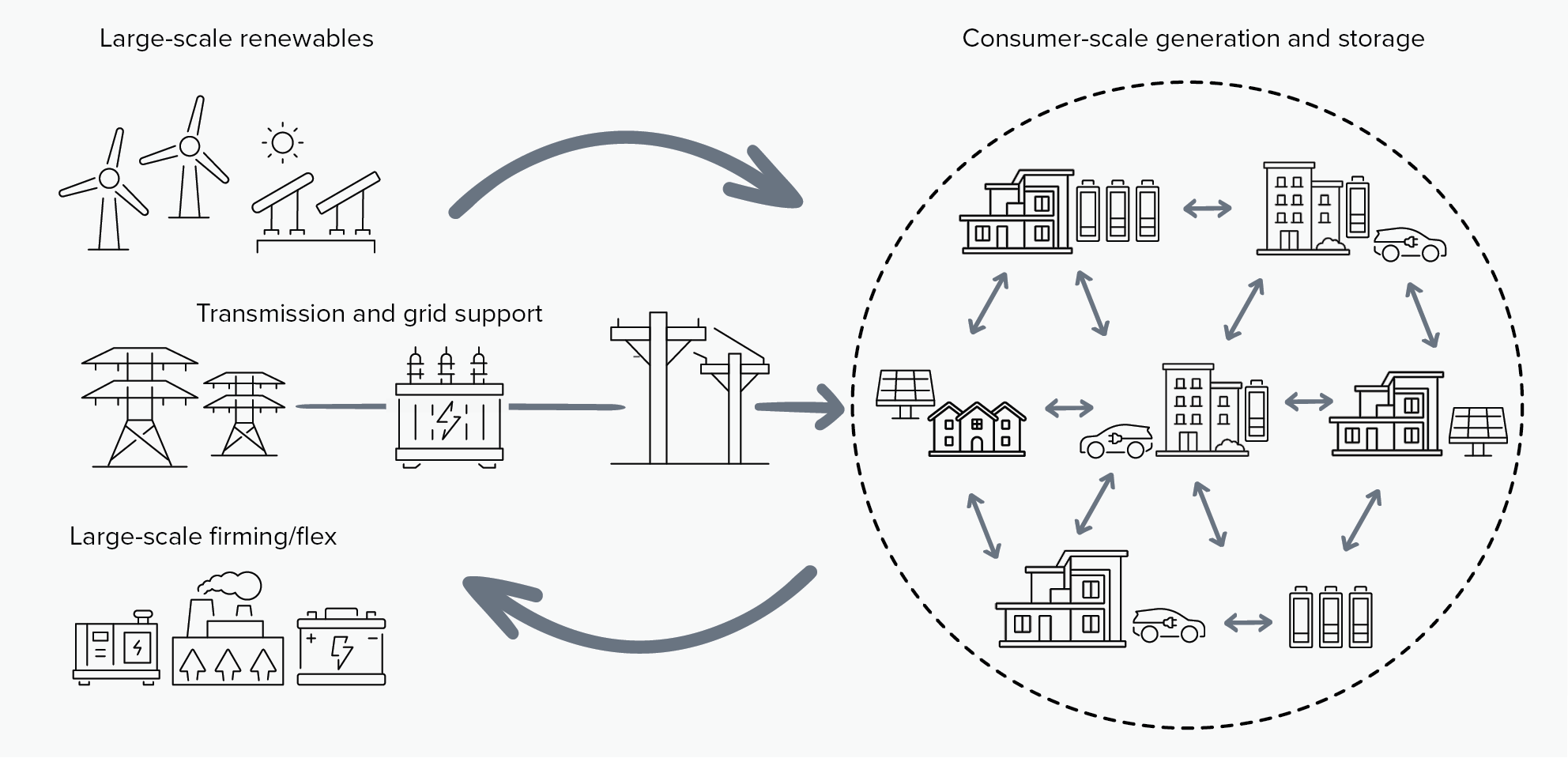
Source: Adapted from National Consumer Energy Resources Roadmap, DCCEEW, 2024, Figure 3
While the private sector is driving the development of grid-scale renewable generation and storage capacity, the public sector has a role in coordinating the energy transition by investing in technology risk, transmission, strategic battery storage and by alleviating any infrastructure bottlenecks that are impeding the rollout of renewables. Ensuring the timely delivery of all these elements of the energy transition will be important to maintaining future energy security. The Australian Government’s National Renewable Energy Priority List identifies 56 priority projects nationally consisting of 24 transmission, and 32 generation and storage projects.
Analysis by Infrastructure Australia identified bottlenecks in transporting over-size, over-mass components for renewable projects, requiring complementary investment in enabling port and road infrastructure and a national, coordinated approach to deliver this freight task efficiently.
Beyond clean energy, achieving net zero requires cutting embodied carbon in infrastructure through modern methods of construction, decarbonising supply chains, and electrifying freight, public transport, and private vehicles. Digitalisation and artificial intelligence (AI) present both opportunities and challenges – Australia’s growing data centre sector will significantly increase energy demand, accelerating investment in renewables, storage, and transmission, while enabling AI-driven optimisation of grid efficiency.
Globally, Australia is well-positioned to export clean energy and fuels, but success hinges on strategic government investments, harmonised frameworks across all levels of government, and strong public-private collaboration to drive innovation and private capital.
_____
xv The NEM is a wholesale market through which generators and retailers trade electricity in Australia. It interconnects the six eastern and southern states and territories and delivers around 80% of all electricity consumption in Australia. This includes coordinated energy resources, generation or storage assets owned by consumers and installed behind-the-meter. These can include rooftop solar, batteries and electric vehicles.
xvi ‘Grid scale’refers to the capacity of electrical generation, transmission, and distribution systems that are large enough to supply power to a regional or national electricity grid.
xvii The NWIS comprises interconnected electricity networks with different owners, public and private. Transmission and distribution assets link the major towns of Port Hedland and Karratha via the Horizon Power network and extend inland through Rio Tinto’s and Alinta’s networks.
xviii Synchronous condensers are large rotating machines that help manage voltage and improve the stability of the power system, so that it is robust to withstand disturbances such as the sudden loss a generating unit or a transmission line. See: https://www.transgrid.com.au/projects-innovation/system-strength-projec…