
Delivering Net Zero and a Clean Energy Economy
Header description
Australia’s transition to net zero will require a rapid scale-up of renewable energy generation, transmission and storage, supported by enabling infrastructure and the decarbonisation of construction and transport.
Renewable Energy Zones
Australia’s energy transition requires coordinated investment in high-quality, renewable energy resource areas where clusters of large-scale renewable projects can be efficiently developed and connected to energy markets. Resource areas are an important planning and coordination mechanism for clustering new generation, storage and transmission infrastructure projects to be developed using economies of scale. In the NEM, these resource areas are called Renewable Energy Zones (REZ), or Renewable Energy Hubs in Queensland. AEMO identifies REZs after engagement with government and transmission network service providers and economic consideration.173 The Western Australian Government identifies key renewable energy resources in The South West Interconnected System Transmission Plan and the Pilbara Energy Transition Plan.
Delivering the scale of renewable generation required to support Australia’s energy transition will depend on deploying new capacity as efficiently and cost-effectively as possible. This requires harnessing high-quality renewable resources, coordinating investment across generation, storage and transmission, and enabling timely connections to electricity networks. Concentrating development in areas with strong resource potential and shared infrastructure can help accelerate delivery, reduce system costs and manage impacts on communities and land use. Achieving this outcome relies on coordinated planning and sequencing of energy infrastructure projects across jurisdictions.
AEMO’s draft 2026 ISP identifies potential REZs across the NEM as critical for the future energy system, with specific REZs designated by individual jurisdictions, such as the five declared in New South Wales and six proposed in Victoria. The Draft 2026 ISP identifies 44 potential REZs including 5 candidate offshore wind zones. AEMO considers REZs crucial for the transition to a renewable-powered grid, noting their development provides a way to efficiently connect new, low-cost renewable energy generation projects to the grid.
Key renewable resource areas in the SWIS of Western Australia are being developed, with major initiatives focused on the Mid West, Goldfield, and South West regions to support the state’s transition away from coal by 2030. The Western Australian Government is establishing ‘renewable generation hubs’ in these areas to connect wind and solar resources.174
In the NWIS, the electricity grid supplying the Pilbara region, the Western Australian Government has identified four transmission corridors to connect high-quality areas of renewable energy to industrial users, mines and communities. The Pilbara accounts for more than 40% of Western Australia’s emissions, primarily from major industrial producers, and utilises less than 2% renewable energy generation. Because of this, the Pilbara will play a central role in meeting Western Australia’s emissions reductions targets. Decarbonising the Pilbara by expanding access to renewable energy is important for the long-term viability of key industries, as the Pilbara contributes nearly 20% of Western Australia’s economic output.175
Efficient development of renewable energy resource areas relies on:
- coordination by the Australian and state/territory governments, including identifying and addressing infrastructure gaps
- new transmission infrastructure to connect these areas, to efficiently and reliably supply consumers.
Figure 6 shows that New South Wales and Queensland have the greatest projected increase to installed REZ generation capacity to 2050. Victorian offshore wind is a sector of generation capacity that is expected to grow from no current generation to 9 GW of installed capacity by 2040, which is over 500 MW of new capacity annually (enough power for 312,000 homes).
Figure 6: Forecast NEM installed REZ generation capacity (GW) 2026 to 2050, by jurisdiction and technology
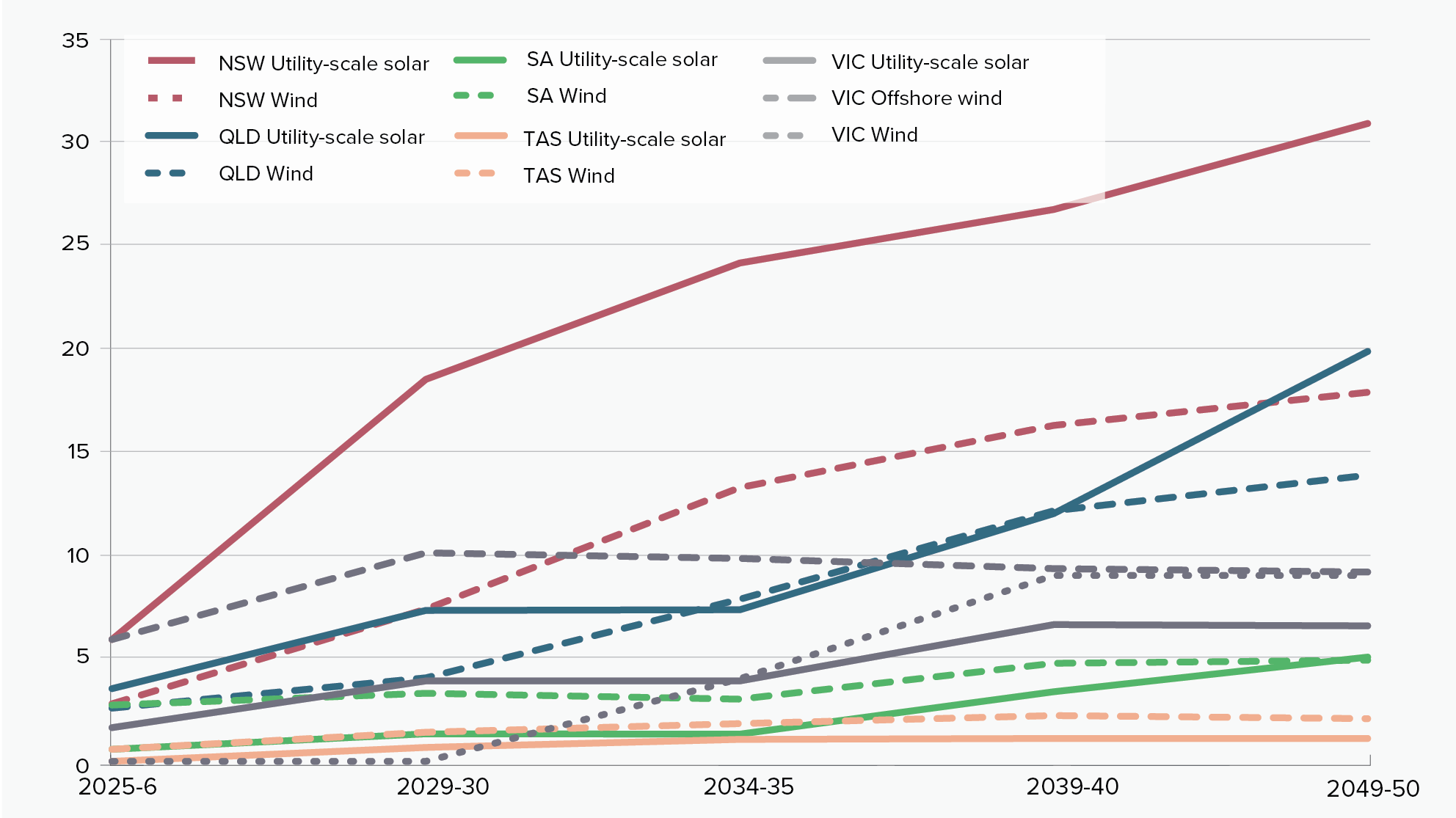
Source: Infrastructure Australia, using data from AEMO, 2025, Draft 2026 ISP Results Workbook, “Installed Generator Capacity by Technology”, CDP2 ‘Step Change – least cost’ scenario
Enabling infrastructure for REZ development
A rapid expansion of renewable energy, particularly onshore wind projects, requires coordinated investments in enabling infrastructure such as ports, freight networks, and transport infrastructure, while managing complex logistics and community impacts.
AEMO’s forecasts indicate that, of 58 GW of new utility-scale wind and solar capacity needed by 2030, 26 GW (45%) is onshore wind – delivery and scaling of onshore wind is therefore a priority over the next five years for Australia to reach its renewable energy targets.
Delivering onshore wind involves importing and transporting many oversized and/or overmass (OSOM) wind turbine components – such as turbine blades, tower sections and nacellesxxv – from ports to project sites. This places immediate pressure on port capacity, the road networks connecting ports to REZs, the broader logistics supply chain, and surrounding communities.
Infrastructure Australia analysed 56 onshore wind projects expected to start construction in the next five years, including all onshore wind projects on the National Renewable Energy Priority List and other more advanced projects within REZs in New South Wales, Victoria and Queensland. Together, these projects are expected to deliver up to 32 GW of planned capacity.
By 2030, delivering these projects will require importing around 4,600 wind turbines through Australia’s ports and transporting more than 62,000 OSOM components to project sites (Table 23).
To support this task, more than 900 identified constraints on the road network may need to be addressed – nearly half of which are on national freight routes and interstate corridors – and ports will need sufficient handling and storage capacity, with some expecting demand of over 17 OSOM movements a day at peak delivery. Upgrades to key routes for OSOM movements will have benefits for other freight, including fuels and agriculture.
The high volume of OSOM movements needed every day, continuously over a period of years also demonstrates the potential for significant impacts on:
- Local communities – a major social licence challenge that governments and developers need to address to avoid delays and increased costs to delivery.176
- Logistics supply chains – the capacity of OSOM transport operators and police escorts required for many OSOM movements is likely to be quickly over-stretched, particularly when coordinating logistics and escort operations across state borders.
- Freight network – rail-road interfaces at level crossings are a constraint that presents coordination challenges, for example at Denman in New South Wales where the OSOM route to Central West-Orana crosses the ARTC Hunter coal-train network.
Infrastructure Australia has previously listed the Lumsden Point development (Port of Port Hedland) on the Infrastructure Priority List, which includes upgrades to enable the import of wind turbines and solar panels to support renewable energy and hydrogen projects for the NWIS in the Pilbara. The Australian Government has committed $565 million to the proposal.
| Jurisdiction | NSW | QLD | SA | TAS | VIC | WA |
|---|---|---|---|---|---|---|
| Number of wind projects analysed | 15 | 17 | 1 | 5 | 13 | 5 |
| Total MW generation capacity to 2030 | 10,238 | 10,232 | 1,000 | 1,684 | 5,751 | 1,713 |
| Total turbine count to 2030 | 1,624 | 1,495 | 135 | 211 | 876 | 244 |
| Total OSOM movements to 2030 | 22,542 | 19,435 | 1,755 | 2,443 | 12,830 | 3,177 |
Source: Infrastructure Australia analysis
Transmission networks to connect renewable energy with consumers
Australia’s NEM relies on over 40,000 km of existing electricity transmission infrastructure,177 with a further 7,750 km of transmission lines in Western Australia’s SWIS and 3,000 km of transmission infrastructure in the NWIS. 178,179
Historically, Australia’s transmission networks have been organised to deliver large amounts of base and peak time dispatchable power from coal-fired power stations. While some REZs are located near former coal zones (such as the Hunter-Central Coast REZ), others are not. This is because REZs are situated in areas of abundant renewable energy resources.
Not only do Australia’s transmission highways need to be re-routed to carry electricity from new areas of grid-scale dispatchable generation to population centres, networks also need to be reshaped to take advantage of grid-scale storage and microscale grids where generation and storage is disaggregated and energy flows are two-way (for instance, rooftop solar, electric vehicle car parks, community batteries). For example, Queensland Supergrid South is a planned transmission project that will connect the Borumba Pumped Hydro project into the NEM, and Southern and Central Queensland with 430 km of high voltage lines.180
Major upgrade and expansion of electricity transmission networks is needed to underpin the energy transition. This requires a coordinated effort across multiple levels of government to ensure grid stability and energy reliability, particularly for manufacturing and industrial users who require predictable supply and cost.
Significant upgrades and expansions of existing transmission networks will be needed by 2050 to connect generation and storage to the grid.165 The NEM is estimated to need 6,000 km of new transmission lines by 2050 and the SWIS over 4,000 km of new high-capacity transmission lines by 2042.165,166
The Australian Government has allocated $20 billion to the CEFC to help deliver Rewiring the Nation, an Australian Government program providing concessional finance to modernise the electricity grid, deliver new and upgraded transmission, and make clean energy more accessible and affordable. The program works with states and territories to support:
- Priority transmission projects identified by AEMO and other network authorities across the NEM and in Western Australia and the Northern Territory.
- Long-duration storage and enhanced electricity distribution networks.
- Measures to strengthen the security, reliability and affordability of the grid, including demand management resources.
- Enhancements to grid infrastructure to support a hydrogen hub or offshore electricity project.
The Draft 2026 ISP identifies ‘actionable’ projects that have been determined by AEMO as part of the optimal development path, that optimises the benefits for consumers (maintain system reliability and connect renewable generation and storage, at the least cost) if progressed within the next two to three years. The following transmission projects have reached financial close, and are expected to add around 1,700 km to the NEM’s transmission network, and reach full capacity between 2027 and 2031:xxvi
- EnergyConnect: a 900 km project connecting the electricity grids of New South Wales, South Australia, and Victoria. CEFC is supporting the project with $295 million in financing.
- HumeLink: a new transmission line connecting the Hume region to the national grid and facilitating the integration of renewable energy sources. CEFC is supporting this project with $1.45 billion in financing.181
- Central West Orana REZ Transmission Project: a project to build the necessary transmission infrastructure for the Central West Orana REZ in New South Wales. CEFC is supporting the project with $750 million in funding.182
- Marinus Link (Stage 1): a proposed subsea electricity and telecommunications connector linking Tasmania with mainland Australia, which will have two undersea cables and is a major project supporting Tasmania’s role in the national energy transition. Marinus Link will be delivered in two stages. Initially as a 750 MW project (Stage 1) with a second 750 MW link to follow at a later date (Stage 2). CEFC financing is expected to be $3.8 billion to support the project.183
These projects will add around a quarter of the 6,000 km of new transmission lines expected to be needed for the NEM by 2050. The Draft 2026 ISP identifies other actionable transmission projects as, that are in the design and approvals phase and have not yet taken a final investment decision or reached financial close. These projects, which are expected to reach full capacity between 2028 and 2034, are also needed to strengthen the connections between jurisdictions, adding reliability and stability to electricity supply across the NEM. Other potential ‘actionable’ transmission projects for the NEM require ongoing analysis, and these will be confirmed in the final 2026 ISP.
The Western Australian Government’s South West Interconnected System Transmission Plan outlines the transmission investments required to facilitate the renewable transition in the SWIS. As coal generation is phased out, the SWIS will need a 9-fold increase in wind and solar renewable energy to enable the decarbonisation and electrification of existing industries.
For the North West Interconnected System, the Western Australia Government has identified four priority corridors under the Pilbara Energy Transition Plan for new common-use transmission infrastructure. These corridors would connect renewable resource areas with ports, mines, and industrial hubs, allow multiple generators and loads to access shared infrastructure, and enable progressive expansion as demand and generation increase.
10-year national priorities
Australia’s energy transition requires coordinated investment in high-quality, renewable energy resource areas where clusters of large-scale renewable projects can be efficiently developed and connected to energy markets such as the NEM, SWIS and NWIS.
Efficient development of renewable energy areas relies on:
- Efficient delivery of onshore wind by ensuring key ports and freight corridor infrastructure is fit for purpose to import and transport OSOM wind turbine components to project sites.
- New transmission infrastructure to efficiently and reliably connect renewable energy areas to consumers.
In the NEM, REZs are important to Australia’s clean energy transition. Investment to remove infrastructure bottlenecks at ports and connecting roads is important to enable the rapid development of REZs. The 2026 Infrastructure Priority List identifies four proposals as priorities for future investment in the 2-4 year pipeline that will support this outcome:
- Enabling infrastructure for Renewable Energy Zones – Port of Newcastle to Central West Orana REZ. The Port of Newcastle is positioning itself as a gateway for Australia’s clean-energy exports and critical minerals supply chains. This will put significant pressure on berth and offloading capacity at the Port of Newcastle, requiring improvements to storage and road access at the port and upgrades to key freight corridors to enable OSOM vehicle movements between the Port of Newcastle and the Central West Orana REZ along the Golden Highway.
- Enabling infrastructure for Renewable Energy Zones – Ports of Newcastle/Brisbane to New England REZ. High volumes of onshore wind projects are planned for construction in the New England REZ in New South Wales. Upgrades on the New England Highway are needed to address height, mass and width constraints, provision of sufficient pull-over bays and rest areas and appropriate bypass routes at key towns such as Muswellbrook and Tamworth to avoid constraints and manage impacts of OSOM movements on communities. Investigating the viability of an alternative OSOM route from the Port of Brisbane to New England REZ that could alleviate demand pressure at the Port of Newcastle is also needed.
- Enabling infrastructure for Renewable Energy Zones – Ports of Adelaide/Geelong to South-West REZ. Greater use of the ports of Adelaide and Geelong to deliver wind projects in New South Wales (including the South West REZ) and Victoria (such as the Western REZ) would enable more efficient delivery and reduce pressure on other ports. Upgrades along the Sturt Highway and routes from Geelong to the border with New South Wales will be needed to address constraints on OSOM movements, such as bridge height and mass restrictions, width constraints at intersections and level crossings, and ensure sufficient pull-over bays and rest areas. Height and width constraints on OSOM access out of the ports of Adelaide and Geelong (Victoria) will also need to be investigated. This proposal relates to South Australian High Productivity Freight Vehicle Network - Future stages which includes the Sturt Highway.
- Enabling infrastructure for Renewable Energy Zones – Port of Gladstone to Central Queensland. The Port of Gladstone is important to support a high concentration of onshore wind development in Central Queensland. There is a need to secure capacity at the port for wind turbine imports, identify preferred OSOM haulage routes out of Gladstone to address key port access pinch points and reduce local community impacts, and investigate upgrades to address constraints on surrounding freight corridors, including bridge mass, height and width constraints on the Bruce, Dawson, Capricorn and Leichhardt Highways.
New transmission infrastructure that connects areas of abundant renewable energy to electricity grids is critical to transitioning to a net zero economy. The 2026 Infrastructure Priority List identifies three proposals as priorities for future investment in the 2-4 year pipeline that will support this outcome:
- National Electricity Market connectivity. AEMO’s Draft 2026 ISP identifies ‘actionable’ transmission investments in the NEM which should proceed to ensure grid reliability, security, and to meet renewable energy targets. This proposal includes transmission projects in design and approvals phases that are expected to reach full capacity between 2028 and 2034 and would enhance reliability and system stability across the NEM.
- South West Interconnected System connectivity. The Western Australian Government’s South West Interconnected System Transmission Plan outlines the transmission investments required to facilitate the renewable transition in the SWIS. This includes the Clean Energy Link Program, a series of transmission projects to connect renewable energy resources in south west Western Australia.
- North West Interconnected System connectivity. Decarbonising mining and industrial activity in the Pilbara by expanding access to renewable energy is crucial for the long-term viability of key export industries and achieving net zero. The North West Interconnected System currently includes the coastal network owned by Horizon Power (public), the inland network from Karratha to Tom Price owned by Rio Tinto (private), and extensive off-grid networks owned by BHP and APA (private). Major electricity customers in the NWIS include the port operations of BHP, FMG, Roy Hill and other miners, Rio Tinto’s port operations and inland mines, and industrial, commercial and residential loads. New common-use transmission that connects high quality, renewable energy resource areas with industrial users and regional and remote communities is important for delivering the lowest-cost transition to renewable energy.
_____
xxv The nacelle is the large housing on top of the wind turbine tower, behind the rotor blades, which holds all the key components that convert wind energy into electrical energy.
xxvi The Optimal Development Path in the ISP is identified as the most optimal and robust pathway to future states of the world. The ODP contains actionable projects, future ISP projects and ISP development opportunities, and optimises costs and benefits of various options across a range of future ISP scenarios.