


 EVALUATION COMPLETE



Perth is experiencing strong population growth, placing increasing pressure on its existing radial rail network and the surrounding road system. Without additional high‑capacity public transport infrastructure, the rail network’s ability to accommodate future travel demand, support emerging growth corridors and enable public transport to carry a greater share of the urban passenger task will be constrained.
The Perth rail network planning proposal responds to this need by planning for additional heavy rail capacity, including new connections to serve growing areas. The proposal aligns with the Infrastructure Policy Statement, Transport and Infrastructure Net Zero Roadmap and Action Plan and the National Urban Policy which emphasise the importance of efficient public transport to connect people with jobs and education, grow housing and lower national emissions through public transport ridership.
PROPOSAL DESCRIPTION
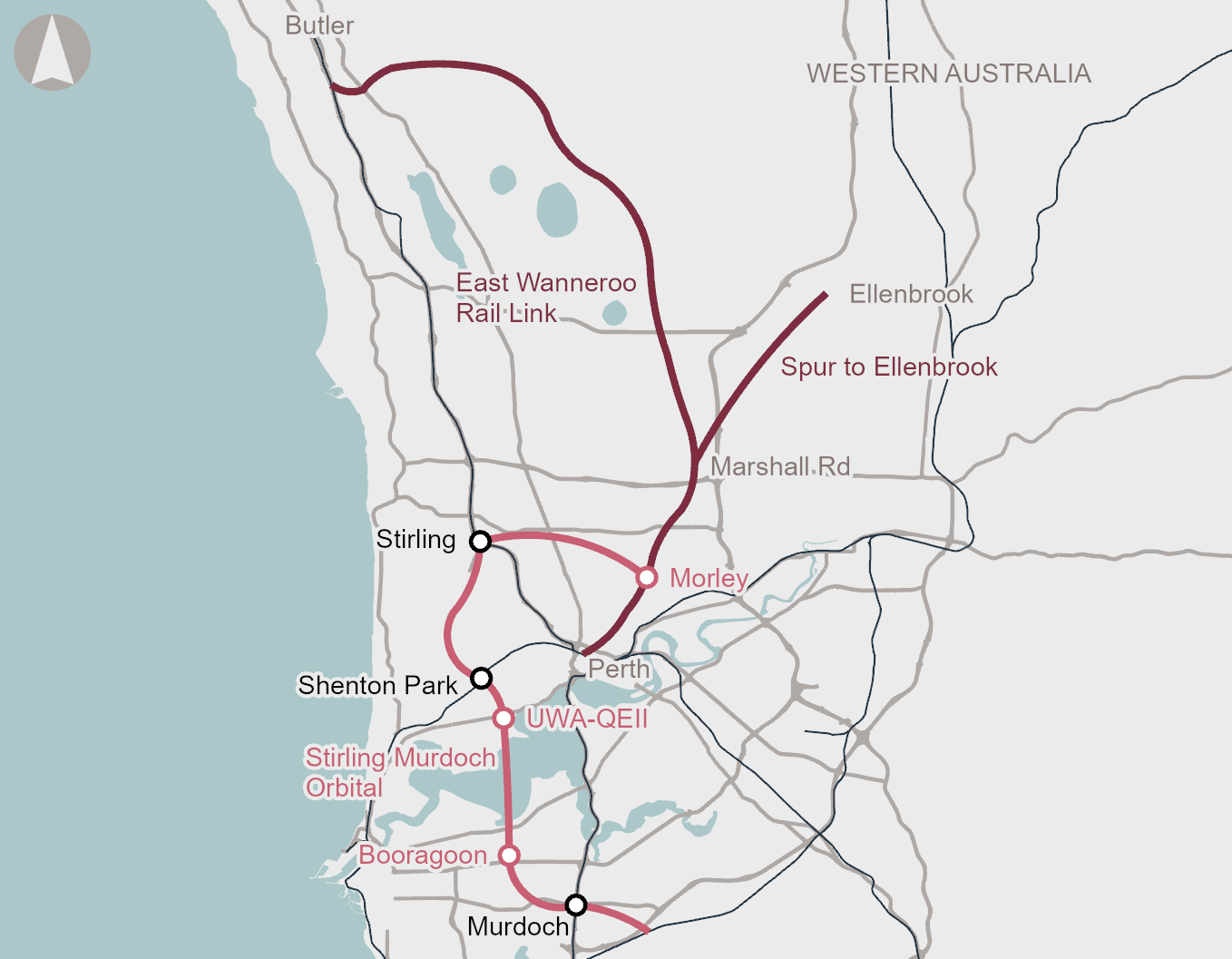
The proposal considers the need for additional heavy rail infrastructure to support forecast population growth and associated travel demand in Perth. This may include a new suburban radial rail line to service Morley and East Wanneroo, connecting to the Joondalup Line to service the far northern suburbs, and/or including a potential future Ellenbrook spur line, focussing on corridors experiencing strong population and housing growth.
A new orbital rail service could provide easier access between major activity centres without requiring transfers through CBD stations. Such an orbital would ultimately allow travel eastward from Murdoch to the Armadale Line, and Stirling to Morley, making a near complete circle around the Perth CBD.
INVESTMENT RECOMMENDATION
The Australian Government should note this proposal as a potential future investment opportunity within the 5-10 year pipeline.
OPPORTUNITIES AND OUTCOMES
This proposal has the potential to:
- Increase metropolitan rail network capacity – additions to Perth’s rail network would increase the network’s capacity to meet forecast population growth.
- Support productivity benefits – improvements in rail mode share for commuters would ease congestion pressures on the road network and complement other public transport services, including buses.
- Support housing and urban growth – better access to high capacity rail transport would support increased housing density and more efficient land‑use outcomes in Perth.
- Improve access to jobs, education and services – improved connectivity between residential areas and major activity centres would enhance labour market access and everyday mobility.
- Support sustainability outcomes – improved access to high capacity public transport would improve the attractiveness of public transport and encourage mode shift from private vehicles, supporting reduced transport emissions and a more efficient transport system.
NEXT STEPS
Proponent to progress development of potential investment options (Stage 2 of Infrastructure Australia’s Assessment Framework), including considering an approach to digital signalling to ensure compliance with European Train Control System (ETCS) standards where metropolitan networks interface with, or provide access to, the National Network for Interoperability.

