


 EVALUATION COMPLETE



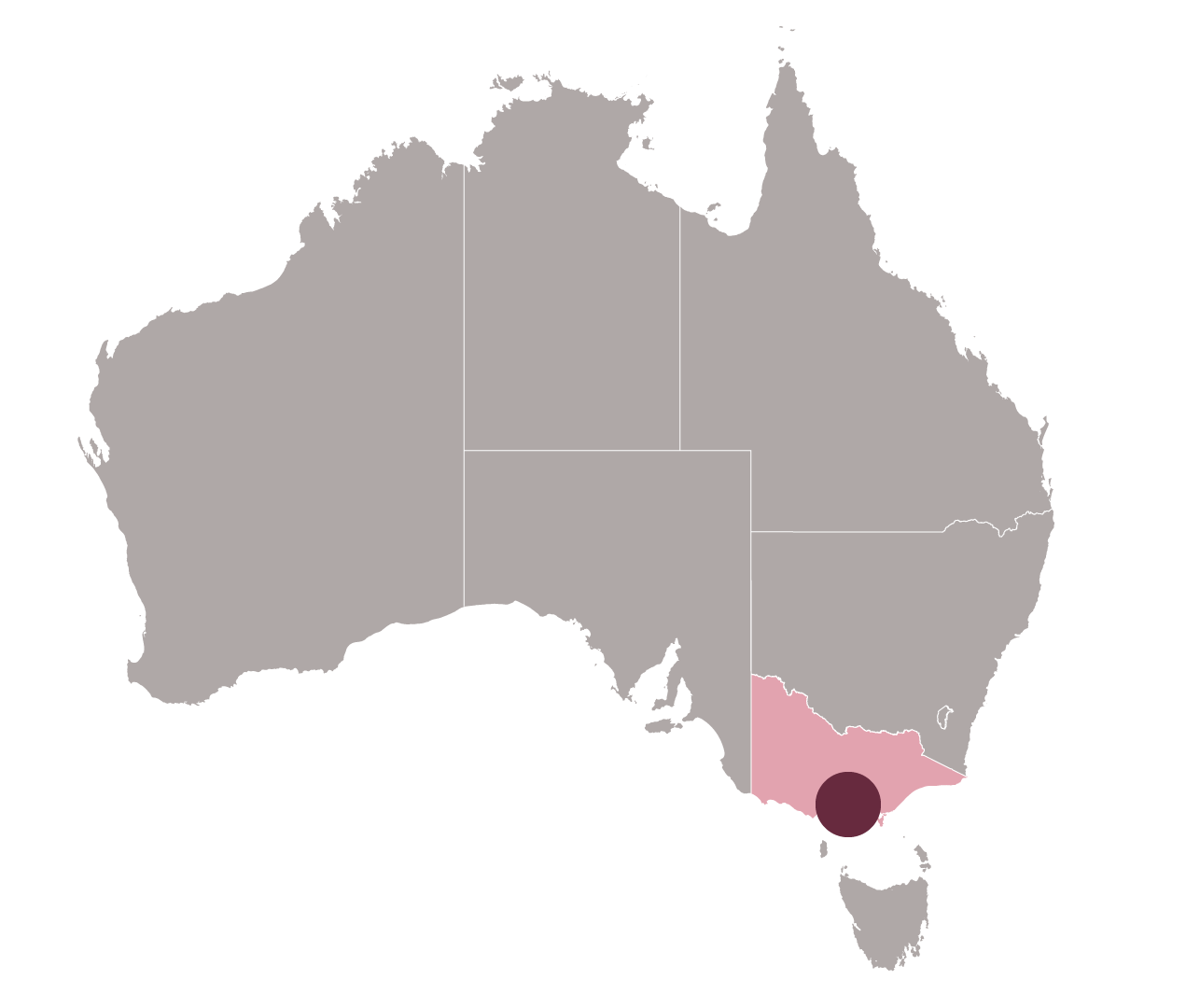
Melbourne’s monocentric urban form, combined with strong population growth in the outer suburbs, is placing increasing pressure on transport networks and contributing to long travel times and constrained access to jobs, services and housing. These challenges disproportionately affect Melbourne’s middle and outer suburban communities, where access to high-quality public transport is more limited.
This proposal for Suburban Rail Loop East is the first stage of the broader Suburban Rail Loop (SRL) mass transit system that will serve Melbourne’s middle and outer suburbs that aims to address these challenges and support sustainable growth in Melbourne. Delivery of SRL East is aligned to the Australian Government’s Infrastructure Policy Statement themes of productivity, public transport network resilience, equity, and connectivity. It also reduces ongoing transport emissions, which is consistent with the Transport and Infrastructure Net Zero Roadmap and Action Plan.
PROPOSAL DESCRIPTION
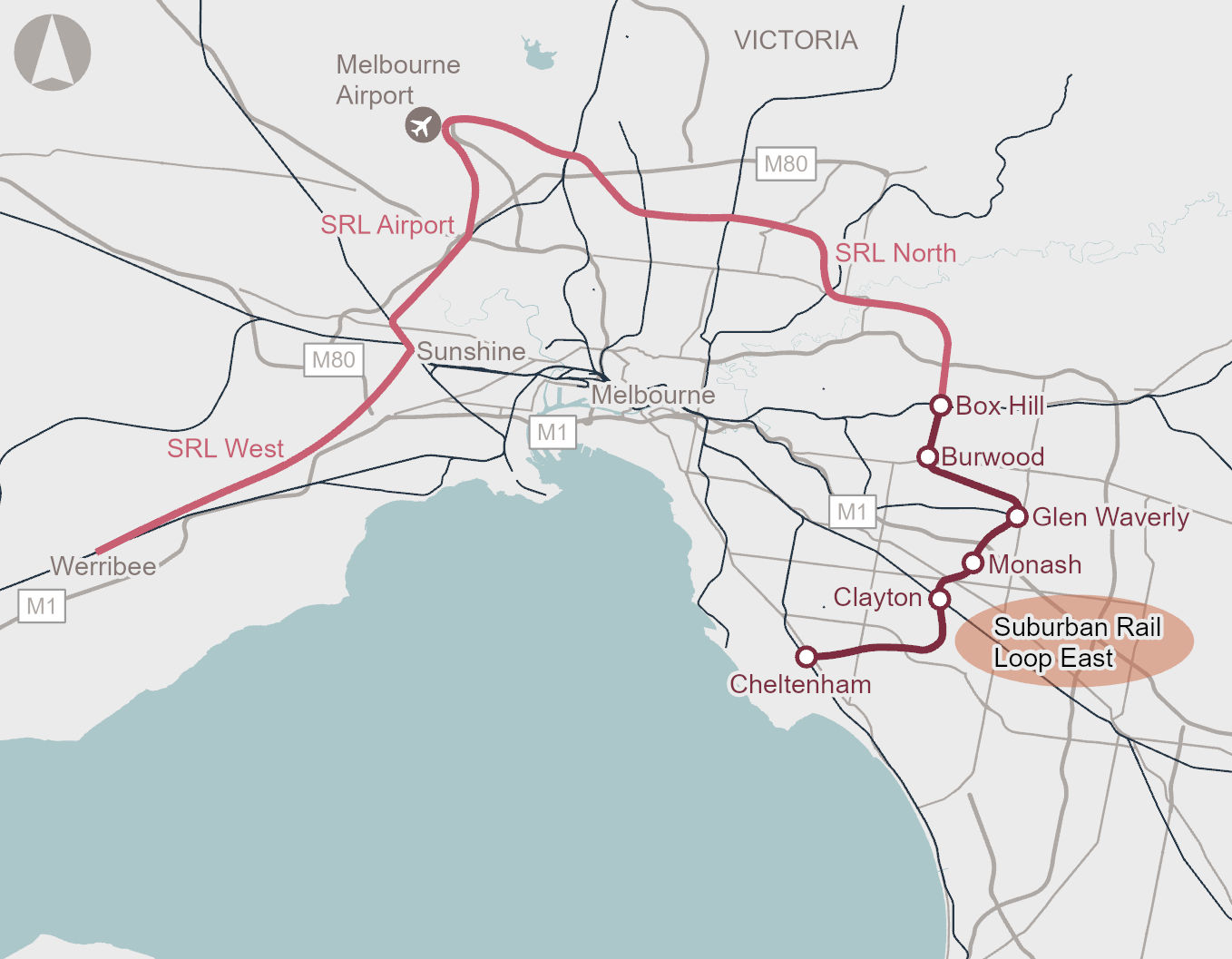
SRL East includes 26 km of twin-tunnels, with six new underground stations at Cheltenham, Clayton, Monash, Glen Waverley, Burwood and Box Hill, as well as a new stabling facility at Heatherton. SRL East is the first stage of the broader SRL system that will improve connectivity for Melbourne’s middle and outer suburbs.
INVESTMENT RECOMMENDATION
The Australian Government should consider prioritising this proposal for additional delivery investment.
The Australian Government has already committed $2.2 billion to towards land acquisition, geotechnical and development works, and utility upgrades across the project area.
OPPORTUNITIES AND OUTCOMES
This proposal has the potential to:
- Improve network connectivity and capacity – delivery of a circular rail link that bypasses the city centre will strengthen suburb-to-suburb connectivity in Melbourne’s middle and outer suburbs, supporting a more connected metropolitan rail network and enabling future growth.
- Increase productivity and accessibility – new stations and improved access to public transport will support reduced transport costs for households, while supporting increased use of public and active transport and reducing pressure on the road network.
- Support liveability, employment and education access – enhanced public transport connectivity to key precincts in Melbourne’s middle and outer suburbs will support improved access to jobs, education and services closer to where people live.
- Support sustainability outcomes – provision of high capacity public transport options will support greater public transport use and reduce reliance on private vehicles.
- Enable housing and precinct development – the creation of precincts and improved access to public transport will support housing development and provide additional housing options along the corridor, helping to accommodate population growth and reduce urban sprawl in outer Melbourne.
NEXT STEPS
The Victorian Government is progressing delivery of SRL East, with three of the five major works packages awarded. The proponent should consider an approach to digital signalling to ensure compliance with European Train Control System (ETCS) standards where the proposal interfaces with, or provides access to, the National Network for Interoperability.

