
Secure, Sustainable Water for Growth
Header description
Australia’s growing population, expanding industries, shifting climate and ageing water assets are increasing pressure on urban, regional and remote water systems, requiring sustained investment in secure, reliable and climate resilient water infrastructure.
Wastewater
As Australia’s water assets age and reach end of life, the services they provide may no longer meet health and environmental standards. Growing supply and demand pressures are placing increasing strain on existing ageing water systems, many of which are not equipped to meet long-term demand.105 Supply systems in regional and remote areas are often old and/or poorly maintained – tanks, pumps, pipelines and treatment plants often reach failure and require frequent repairs.158
Significant proportions of water and wastewater networks across Australia are concurrently reaching the end of their useful life,159,160 and increased investment is likely to be required for asset renewals and upgrades over the coming decades (Figure 1). For example, it is anticipated that for South Australia alone, approximately $12.9 billion investment will be required for the renewal of water and wastewater assets over the next 30 years.159 Ageing and poorly maintained wastewater and drinking water assets increase the likelihood of system failures, non-compliance and service disruptions, risking public health and environment protection outcomes. Continued investment in maintenance and upgrades of water and wastewater infrastructure is required161 to meet Australia’s water needs, now and in the future.
Figure 1 outlines the expected amounts of planned capital expenditure in wastewater and water capital expenditure into 2029-30, highlighting the increasing expenditure that is expected to be required on renewals, compliance and growth.
Figure 1: Capital expenditure (capex) in wastewater and water, 2022-23 to 2029-30
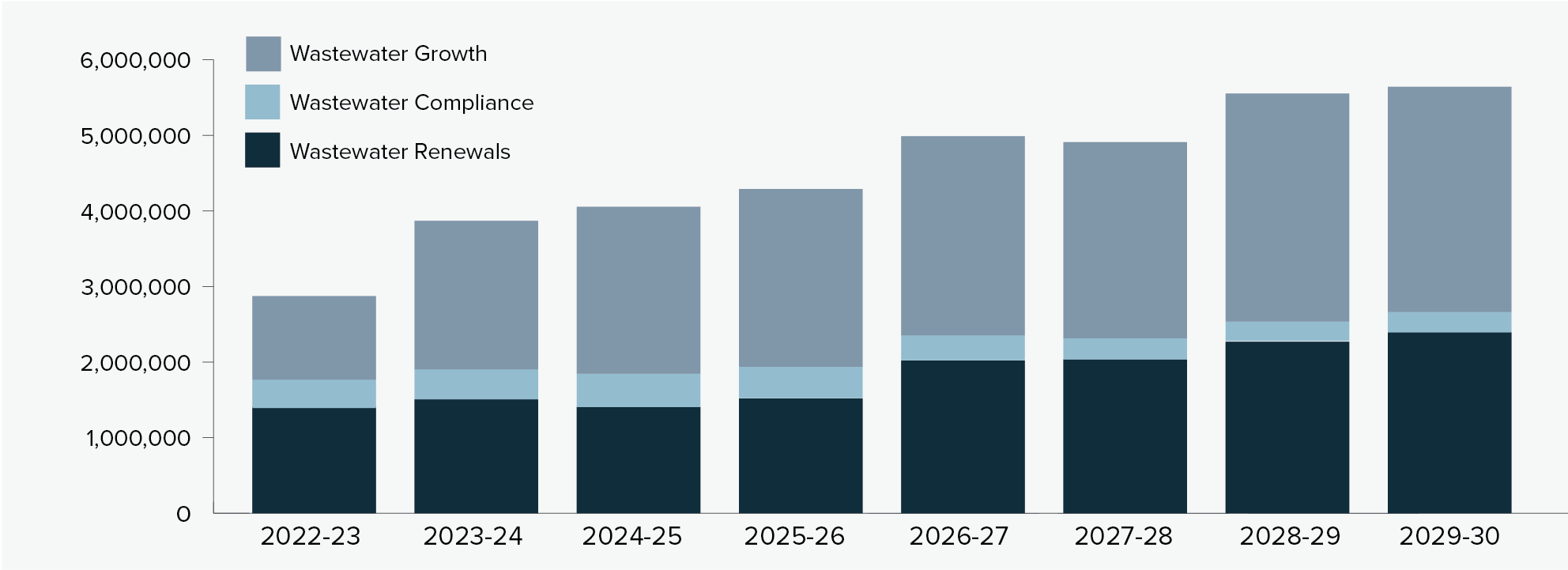
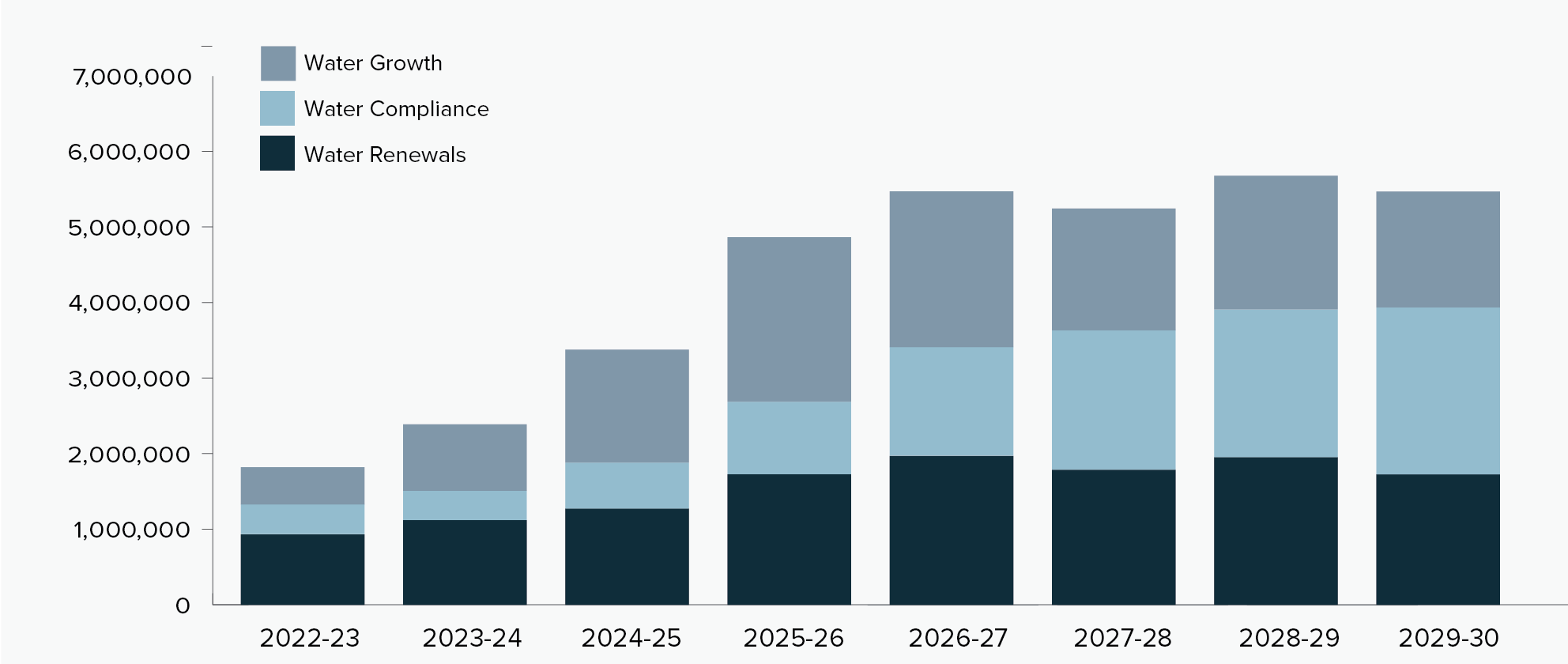
Source: Water Services Association of Australia, 2025 forecasts
Modernising wastewater treatment
Climate change, population growth, and ageing assets are placing unprecedented pressure on the capacity of wastewater treatment plants in Australia. Higher temperatures and extreme weather events increase variability of stormwater inflow and infiltration and nutrient loads, while droughts limit the dilution capacity in receiving waterways.162 Population growth is driving higher sewage volumes, and expanding industrial and commercial sectors – such as food processing, manufacturing, and tourism – generate complex wastewater streams with higher contaminant loads.
Table 20 highlights the number of treatment plant assets across Australia that will require ongoing maintenance and upgrades to ensure service reliability under future conditions.163
Sewage discharges introduce nutrients, pathogens, pharmaceuticals, and contaminants into waterways, leading to ecological and public health impacts. High nutrient levels can trigger algal blooms harmful to aquatic life,164 while pathogen-rich effluent triggers beach closures and public health alerts. Emerging contaminants such as microplastics, Per- and poly-fluoroalkyl substances (PFAS) and other “forever chemicals” are also a growing challenge for wastewater systems and existing treatment processes. While some treatment technologies exist to reduce many of these contaminants, implementation of these can be high cost and energy intensive.165
Significant investment is likely to be required to ensure wastewater treatment plants can cater to a growing population while addressing these emerging challenges. For example, TasWater’s Master Plans indicate that 70 of Tasmania’s 110 sewerage treatment plants will require improvements or upgrades between now and 2050 to cater for population growth and meet water quality requirements for discharges to waterways. Upgrades to advanced technology and increased capacity of wastewater treatment plants will also unlock opportunities for recycled water use by enabling higher-quality water suitable for various end uses.
The National Water Grid Fund is not used to directly fund wastewater and stormwater projects, except where they include a productive economic element such as recycled water schemes. However, the Australian Government has committed funding to deliver sewerage network infrastructure through other mechanisms. For example, under the Launceston City Deal, the Australian Government, together with the Tasmanian Government and City of Launceston, committed $140 million to deliver infrastructure upgrades to reduce overflows from Launceston’s combined waste and stormwater system.
| Region | Number of wastewater treatment plants |
|---|---|
| ACT | 4 |
| NSW | 188 |
| NT | 7 |
| QLD | 144 |
| SA | 34 |
| TAS | 110 |
| VIC | 216 |
| WA | 23 |
| Total | 726 |
Source: Infrastructure Australia analysis of BOM 2025, National performance report 2023–24: urban water utilities data National performance report 2023–24: urban water utilities, part A
10-year national priorities
Ageing wastewater infrastructure can have significant impacts to the health of communities and the environment. Upgrades to wastewater infrastructure is a national priority to meet contemporary standards and support housing development. The 2026 Infrastructure Priority List includes the following proposals as immediate priorities for planning investment:xiv
Launceston Sewerage improvement program – this proposal includes detailed investigations for a consolidated sewerage plant to meet environmental standards. The proposal supports population growth and housing development in Launceston.
Bolivar Wastewater Treatment Plant capacity – the proposal aims to increase the capacity of the treatment plant and increase use of recycled water to improve the security and sustainability of water supply in Adelaide’s northern growth areas. The Australian Government previously committed $2.5 million in planning funding for a study that investigated options to augment the Bolivar Wastewater Treatment Plant, which led to subsequent investment in the related Northern Adelaide Irrigation Scheme project.
_____
xiv Infrastructure Australia recognises that while Launceston Sewerage Improvement Program and Bolivar wastewater treatment plant capacity upgrades may support future adaptability to support water reuse, they are not eligible for Australian Government funding under the NWGF.