
High Productivity Freight Networks
Header description
Australia’s freight networks are the backbone of domestic supply chains, enabling the efficient movement of goods across vast distances and supporting the nation’s economic growth and resilience.
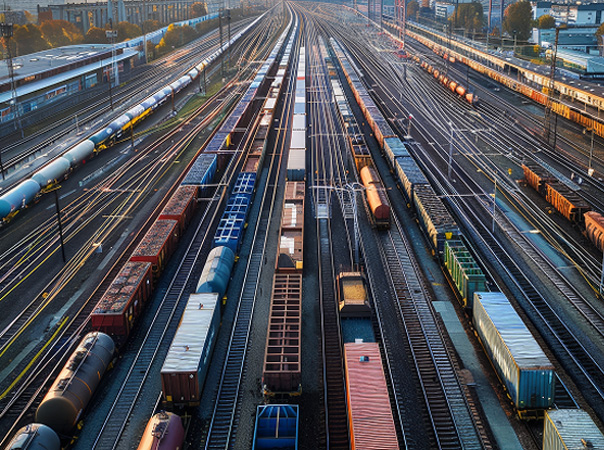
Rail freight
Rail freight plays a crucial role in meeting Australia’s growing freight task. The shift of freight from road to rail will significantly reduce road congestion, lower GHG emissions, increase productivity and enhance network reliability and road safety. Rail freight produces 16 times less carbon emissions per tonne-kilometre compared to road freight, highlighting the impact of rail in supporting Australia’s decarbonisation goals.14
Despite these benefits, rail freight remains concentrated in the movement of bulk commodities such as iron ore, coal and grain, with over 70% of bulk freight moved by rail in 2024-25. Rail freight is less utilised for the movement of containerised and other non-bulk goods, with only 16% of non-bulk freight moved by rail in 2024-25.15 Rail’s competitiveness increases with distance, which is demonstrated by the rail mode share of non-bulk freight being highest along the east-west corridor between eastern states and Perth.16
Strategic and coordinated investments are essential to unlock the full potential of rail in the national freight network. These investments include modernising rail infrastructure, improving interoperability of rail systems, dedicated freight railways, and strengthening regional connectivity. Systematic investment in these measures will increase freight productivity and resilience and support Australia’s long-term competitiveness in global markets.
Enhancing rail network connectivity and productivity through the National Network for Interoperability
The National Rail Action Plan (NRAP) provides a coordinated framework to address systemic challenges and drive reform across Australia’s rail system. The NRAP focusses on harmonising technical standards and operational practices to achieve interoperability across jurisdictions, building workforce capability and driving innovation through adoption of digital technologies.
Advancing interoperability across Australia’s rail network is a central focus of the NRAP. The National Transport Commission, in collaboration with government and industry, defined the National Network for Interoperability (NNI) to improve the efficiency and competitiveness of Australia’s rail system. The NNI maps interstate freight and passenger lines and identifies critical interfaces where consistent signalling, control systems and asset management practices are essential to expanding the role and productivity of rail in national freight and passenger transport networks. To support the objectives of the NNI, Australia’s infrastructure and transport ministers have agreed to adopt a unified digital signalling technology – European Train Control System (ETCS) – across major corridors. Any future digital train control and signalling system introduced on the NNI is to comply with ETCS mandatory standards.
Strategic investment in the NNI and other network connections that it supports, including high productivity rail corridors and intermodal terminals, will be essential to support a shift of freight from road to rail.
This includes leveraging automation and technology – such as digital train control, predictive maintenance and real-time freight systems – to optimise network capacity, enhance safety and deliver supply chain efficiency. Mode shift from road to rail will be essential to meeting future freight demands sustainably, supporting reduced emissions and improved freight performance.17 To maximise interoperability and efficiency, consistent skills and capabilities across the network are essential, ensuring that all operators can manage assets to the same high standard.
Australia’s interstate rail freight network plays an important role in supporting long-distance freight movements and national supply chain resilience. The Australian Rail Track Corporation (ARTC) manages a network that spans over 9,600 km and operates under a unified set of infrastructure, operational and rolling stock standards – including consistent track gauge. ARTC’s signalling systems are also being progressively updated to adopt uniform standards across the network.18
The ARTC is also responsible for the delivery of Inland Rail, a dedicated freight line connecting Melbourne and Brisbane supporting 1,800 metre, double stacked trains and transit times under 24 hours. Inland Rail will support double stacked services between a new intermodal terminal at Beveridge in Victoria and a proposed intermodal terminal at Ebenezer in Queensland, with 39 km of further single-stacked operations to continue to Kagaru.16 Inland Rail is expected to support a road-to-rail mode shift equivalent to removing 200,000 heavy vehicle movements per year on key inter-capital corridors, which will deliver significant benefits from supply chain efficiencies safety improvements, and congestion reduction.19 Projects like Inland Rail are also expected to boost investment in sectors such as agriculture processing and freight logistics.20
10-year national priorities
Australia’s growing freight task and decarbonisation goals require targeted investment aligned to the NNI, which is needed to realise greater mode shift from road to rail.
Advancing interoperability on the NNI is a national priority to improve the productivity and competitiveness of Australia’s rail network. The 2026 Infrastructure Priority List includes the National interoperability of digital signalling and train control proposal as a priority for future investment in the 2-4 year pipeline, following planning activities to define trackside infrastructure requirements by relevant jurisdictions and the ARTC. This national proposal relates to other 2026 Infrastructure Priority List proposals captured in the High Capacity Transport for Growing Cities section for delivery of high-capacity signalling within Australian capital cities. This would support further rail system harmonisation and integration beyond the extent of the NNI into urban rail networks.
Inland Rail is a key component of the NNI, and its completion will support delivery of the NNI’s full benefits. Inland Rail is being delivered in a staged approach, prioritising construction from Beveridge to Parkes by 2027.21 The 2026 Infrastructure Priority List includes the NSW Inland Rail interface improvements proposal as a future investment opportunity in the 2-4 year pipeline to deliver interoperability upgrades and maximise freight benefits from Inland Rail. There are further opportunities to improve network interfaces with Inland Rail, such as with agricultural freight in Darling Downs, Parkes-Perth corridor, and connection to Melbourne-Adelaide freight corridor (see Melbourne Outer Metropolitan Ring / E6 transport corridor listing below).
Increasing intermodal capacity and connectivity
Intermodal terminals are critical infrastructure nodes that facilitate the transfer of freight between transport modes – primarily rail and road but also shipping and air – and form the backbone of efficient national freight flows. Broadly, intermodal terminals consist of two subsystems: one servicing port-oriented import/export movements and the other supporting domestic freight transfer.22 While these operations often function independently, some terminals cater to both.
To meet future freight demands and support decarbonisation, the National Freight and Supply Chain Strategy calls for increased use of integrated intermodal precincts that optimise modal transitions by co-locating supply chain services. The Australian Government through National Intermodal Corporation is progressing delivery of the Beveridge Intermodal Precinct (BIP). BIP is set to become Australia’s largest intermodal precinct, which is strategically located on the NNI as part of the Inland Rail route.
10-year national priorities
Integrated intermodal terminals are needed to improve freight productivity and enhance connectivity across the NNI. The 2026 Infrastructure Priority List identifies proposals that support the development and enhancement of intermodal terminal capacity on the NNI, including the South East Queensland intermodal terminal capacity proposal, which is identified as a future investment opportunity in the 5-10 year pipeline to provide additional intermodal terminal capacity to support the growing freight task in South East Queensland, with the capability to meet future operating requirements of Inland Rail through a proposed new intermodal terminal at Ebenezer.
The Melbourne intermodal terminal capacity proposal is also included on the 2026 Infrastructure Priority List. This proposal is planning to develop a well-located terminal to provide additional rail freight and intermodal capacity and connectivity, noting potential connection of the Western Interstate Intermodal Terminal (WIFT) to the proposed Outer Metropolitan Ring Rail in the future. The WIFT is identified as a longer-term investment priority in the 5-10 year pipeline as the immediate focus is on delivering the Beveridge Intermodal Precinct to support Inland Rail, with WIFT to follow when additional capacity is needed.23
Expanding intermodal terminal capacity is key to meeting future freight demand and strengthening supply chain resilience. The 2026 Infrastructure Priority List includes the Western Sydney Freight Line and Intermodal Terminal proposal as a priority for future investment in the 2-4 year pipeline to boost intermodal terminal capacity in Western Sydney, supported by dedicated freight rail connectivity from the Southern Sydney Freight Line, which connects to Port Botany. The 2026 Infrastructure Priority List also identifies the Northern Territory freight rail and logistics capacity improvements proposal as an immediate priority for planning investment to support local supply chains and connectivity to the national transport network. The Australian Government has committed $440 million in planned equity to develop regional logistics hubs along the Darwin-Tarcoola rail line, which is part of the NNI. Further planning is required to progress this proposal, which will increase supply chain capacity and resilience for the Northern Territory. By improving rail efficiency and intermodal capacity along this rail corridor, the proposal supports industry development within the mining, agricultural, energy and gas sectors.12
Improving intermodal terminal connectivity is needed to enable seamless road-rail integration and optimise network performance. The Melbourne Outer Metropolitan Ring / E6 transport corridor proposal is included on the 2026 Infrastructure Priority List as a priority for future investment in the 5-10 year pipeline to support stronger connectivity in Melbourne’s north and west. The proposal includes the Outer Metropolitan Ring Rail South project that would deliver a new rail link connecting the proposed interstate freight terminal (WIFT) at Truganina to the national freight network. The proposal also supports the long-term development of a multi-modal transport corridor improving freight connectivity between existing and planned trade gateways.
Improving resilience and safety of rail freight networks
Infrastructure Australia has recognised the importance of enhancing and building infrastructure to support regional road and rail freight resilience through a previous Infrastructure Priority List proposal drawing on the findings of the 2023 Road and Rail Supply Chain Resilience Review. Resilient freight corridors are important because they underpin the reliability of Australia’s supply chains, particularly for regional and remote communities that depend on key routes for access to goods, services and economic activity. Natural disaster risks are forecast to increase in intensity and frequency as Australia’s climate changes, which further highlights the importance of strengthening freight corridor resilience to safeguard communities from escalating disruption risks.24,25
The 2023 Road and Rail Supply Chain Resilience Review assessed 13 critical rail supply chains from the National Key Freight Routes (KFR) to develop a better understanding of Australia’s rail resilience. These routes connect nationally significant freight hubs – ports, airports and intermodal terminals – and comprise a key part of Australia’s supply chain infrastructure. Five critical rail KFRs were determined to have a high or very high vulnerability rating, which means there is a high or very high risk of natural hazard disruption and high or very high proportion of freight obstructed – see summary in Table 2.
| Rail Key Freight Routes | Manager | Change (%) in freight along alternative road routes | Key sector/s |
Vulnerability rating |
|---|---|---|---|---|
| Western Australia Transcontinental Line | ARTC | Great Eastern Highway (271%) | Iron ore, grains, general freight |
Very High |
| South Australia Transcontinental Line | ARTC | Eyre Highway (133%) | General freight |
High |
| Queensland Great Northern Line | Queensland Rail | Flinders Highway (92%) | Minerals |
High |
| Queensland Western System | Queensland Rail | Warrego Highway (107%) | Coal |
High |
| New South Wales Main West Line | ARTC | Alternate rail route for 19% of freight, remaining freight completely obstructed. | Mining |
High |
Source: Road and Rail Supply Chain Resilience Review – Phase 1
The table shows that all rail KFRs with high or very high vulnerability are east-west connections, two of which comprise the East-West rail corridor that connects Sydney to Perth. Disruptions to these rail corridors cause major issues given freight volumes are often too large to practically shift to road, leading to significant economic and logistical consequences.
Three of the five most vulnerable rail KFRs are managed by the ARTC, which is delivering the $1 billion Network Investment Program across its interstate rail network, with a focus on improving safety, resilience and reliability of the network. High vulnerability ratings across the two Queensland Rail corridors indicates a need for targeted upgrades to improve east-west resilience along these corridors.
Building resilience across critical rail KFRs is one part of the challenge – ensuring operational continuity and safety within the network is equally important. Robust rail connections reduce economic risk during disruptions, but hazards such as level crossings must be addressed to improve safety and maintain efficient operations.12
Level crossings remain the highest public safety risk on the rail network (excluding suicide and trespass) – with 15 people losing their lives due to rail-related accidents in 2023.12 The removal of level crossings from our transport network supports improved productivity and increased safety by enabling more efficient rail and road movements and reduced conflict.
The movement of high productivity and oversized and/or overmass (OSOM) freight often requires road access across high-traffic rail freight corridors, creating complex network interface challenges. These interactions can cause delays for both road and rail users, reducing overall network productivity and highlighting the importance of coordinated infrastructure solutions at critical level crossings.
Removing level crossings located on the National Land Transport Network (NLTN) and KFRs supports improved safety and efficiency of both freight and passenger transport networks, including local networks. It also delivers benefits for commuters by reducing delays and improving travel reliability in urban areas. Table 3 shows the number of level crossings on the NLTN and KFRs by jurisdiction and capital city, showing clusters of level crossings in metropolitan areas of Adelaide, Melbourne and Perth.
Melbourne has the second highest number of level crossings on the NLTN and KFRs out of Australia’s capital cities, behind Adelaide. The Victorian Government is delivering the Level Crossing Removal Program to remove 110 high risk, congested level crossings in Melbourne by 2030, with 88 removals already complete.
The South Australian and Western Australian governments are developing similar level crossing removal programs to address safety and congestion issues from high risk level crossings in Adelaide and Perth. In addition to state or territory-led programs, the Australian Government has supported the removal of level crossings as part of the delivery of nationally significant infrastructure projects.
As shown in Table 3, there are many level crossings in regional and remote areas of Australia on the NLTN and KFRs. The National Level Crossing Safety Strategy emphasises technology adoption and coordinated national action to work towards zero harm at level crossings. To address level crossing safety risks in regional areas, the Australian Government is delivering the Regional Australia Level Crossing Safety Program, which includes investment in lower cost safety protections, research funding, data improvement grants and education and awareness.
| Jurisdiction |
Level crossings |
Capital city |
Level crossings |
|---|---|---|---|
| ACT |
3 |
Canberra |
3 |
| NSW |
18 |
Sydney |
3 |
| NT |
6 |
Darwin |
1 |
| QLD |
125 |
Brisbane |
0 |
| SA |
48 |
Adelaide |
22 |
| TAS |
4 |
Hobart |
1 |
| VIC |
65 |
Melbourne |
17 |
| WA |
84 |
Perth |
12 |
Source: Infrastructure Australia analysis of OpenStreetMap (OSM) level crossings data. Highlighted cells indicate values that are above the average for their respective column.